Spending Time
How effectively are you spending your time in training?
It’s called spending time for a reason.
Time is finite. We only have a certain amount.
Like money, we only have so much.
Unlike money, we can not make more.
Your time can be an investment that pays you in results.
So how do you spend your time in the gym?
Are you spending 20 minutes foam rolling, but not seeing any results?
Are you spending an hour of your day in a fitness class but not seeing any progress with your pain or limitations with specific movements.
How do we spend our time better in the gym?
First, think about what is important to you. Think about what you would like to prioritize in the gym. Do you want to feel less pain? Feel less stressed? Accomplish a specific movement?
Second, identify the low-hanging fruit. Find what things get you the most out of the time that you are spending.
Is that 20 minutes of foam rolling the most cost-efficient use of your time if you only have 1 hour to train. Very unlikely that it is.
Not sure what your low-hanging fruit is? That’s ok! That’s the role of a coach. To learn about you and assess your needs and goals so we can find a starting point.
Missed Workouts
What happens when you miss a workout?
So you missed a workout.
Does this mean you failed? Does this mean you need to catch up?
Absolutely not.
To me, it doesn’t matter if you had no reason to miss that workout or if you had the best reason in the world.
The response is still the same.
It’s OK. We move forward.
There are 365 days a year. No one is perfect. To expect perfection is unreasonable.
For any goal, consistency will lead to results with a thought-out process. Just because you missed one day does not mean you are inconsistent. It doesn't need to define you.
Missing a day could mean that your body needed rest.
It could mean that life happened.
And for me as a coach, it means the next steps are important. And dwelling on the past isn’t a step I want us to make.
Sure, let's learn from the past if we need to. But we need to move forward.
Moving forward means we continue the process that we have already committed to together.
That process doesn’t include trying to add more to your plate because of something that happened in the past.
Gendered Workouts. Why?
Why are there gendered workouts?
Does your gym or training program have gendered workouts?
Does your gym or training program say that they are for everyone?
To me those two things, if both true, are at odds.
Some will use gendered workouts to assign a prescribed weight or volume to an athlete. It is said that if you cannot yet do that weight or volume that you can scale or modify to meet your ability based on gender. For some this could be motivating and give them direction for progression.
Not everyone fits into the mould of being male or female. As such gendered workouts are not for everyone. They are for those that identify as those genders.
We need more inclusive gyms.
When we assign genders to exercise, we exclude those that don’t fit a bias.
Sure progression is important. But that is the role of coaching. Progression isn’t writing a weight for a gender and saying this is what you can eventually get to based on your gender.
Progress based on goals, not gender.
How can you indicate the difficulty or intensity of something without using genders?
I use RPE or Rate of Perceived Exertion. It’s completely individual because everyone perceives events or tasks differently. It’s how difficult something feels to you on a scale of 1-10.
There are other ways to do this. It could be % of a previous lift. It could be a pace based on a previous measured task. It could be based on heart rate or breathing.
It just doesn’t need to be based on gender.
If we are going to say we are for everyone, let’s make sure we aren’t excluding anyone.
The Roadmap
This is the roadmap to results.
You’ve hit a fork in the road. There is an obstacle in your way. Your training isn’t progressing the way you want it to.
This process is for you. This is how we achieve your goals together.
Step 1: Locate.
What good is a map or GPS if you have no idea where you currently are? Maybe you can see the end destination but you have no idea where you are. This gets us nowhere or even going in the wrong direction.
So we assess. We look at your current abilities and other factors that play a role in your progress (lifestyle, stress, sleep, food, support, etc). This is our starting point.
Step 2: Move.
We chart our course. We address the roadblocks that you have. Sometimes this requires taking 1 step back to take 2 steps forward. We find the most optimal course for you. This is the direction that we feel the most confident in being able to execute on.
Step 3: Cruise
We continue making progress. Some goals take longer to achieve, while some can be achieved rather quickly. We trust the process and find our cruise control. No need to push the limits if we don’t have to. Very few goals require a rushed process.
What to know more? Comment below!

Sissy Squats?
Sissy squats. Is this an appropriate name?
First off. I have made the mistake of using this name for this movement.
Occasionally I will get people asking me why certain movements are named the way they are. This is one of those movements.
I have heard two reasons for this naming.
The first is that it was named after Greek legend, King Sisyphus. He was punished for cheating death twice by being forced to roll an immense boulder up a hill only for it to roll down every time it neared the top, repeating this action for eternity.
The second is from bodybuilder Monte Wolford. While warming up for a competition he was performing these squats. A competitor said “what is that Sissy exercise you are doing”. He challenged the competitor to do 3 sets of 10. After completing them the competitor fell off the stage due to muscle fatigue.
Now, who knows which reason came first. But here’s the thing: the word “sissy” is not our word to use.
From @safegymtraining
The words “sissy” or “fairy” were often used in reference to a feminine man, in appearance or mannerisms. This term is now being reclaimed by Drag Queens who emphasize the feminine aspects of their performance, an example is “sissy that walk”.
So let’s stop using the word in the fitness space. Or as a derogatory term for that matter.
Let’s call it what it is: A knees over toes squat. Because that's what you do.
By letting knees go over toes in this fashion while assisted or assisted (harder), we can train our toe strength, our knees tolerance to loading and our quads.
Scaling is Stagnant
How long have you been scaling?
You’ve scaled the same movement for months due to pain with ZERO progress.
You’ve listened to the scaling or modification options provided by your gym.
And you keep showing up and putting in the work. You are making progress in certain areas but that one movement still causes you pain.
That’s frustrating, I’ve been there. You invest your time, money and energy into that gym or that fitness program.
This is important to you. You are ready to make this a priority.
You want results! You want to do that movement that you see others doing.
How do we change this and get you on the path to progress?
We look at what is required from that movement. We assess your capabilities. We find the important areas to work on. We ask each other questions to learn more. We commit to a customized plan to set us on the path to the results.
Scaling options that aren’t specific to you are not specific to your needs or your goals.
Scaling is stagnant. It’s the red light that keeps you at the intersection, delaying your progress to your intended destination.
Customization>Scaling.
Running Into Trouble?
Running does not need to cause trouble.
Are you having some difficulties with running?
Maybe you are having foot, ankle, shin, knee, hip or back pain.
Maybe you want to increase your speed. Or endurance.
Maybe you want to run a marathon. Or your first 5k.
Regardless of your goal, we are going to assess the thing that hits the ground first.
We are going to assess your feet and ankles.
We are going to look at your ability to point your toes. We look at this in the kneeling butt to heel test.
We are going to look at your ability to bend at the ankle. We look at this in the ankle dorsiflexion test.
We use this information (along with other assessments) to find any low-hanging fruit to work on so that we can get you started in the right direction for your goals.
Going Low Enough?
Are you squatting low enough?
Are you going low enough in your squat?
It's easy when watching a video or seeing a photo of someone doing something to quickly jump to criticism.
Maybe it's done in a way that is different than yours.
Maybe some coach has told you it will lead to injury.
Maybe you don't think the technique is correct.
But the first question to ask is: why might they be doing it that way?
Sometimes we aren't going low enough. Sometimes we need coaches or tools for accountability.
Sometimes going low just isn't beneficial for the performance of a task or sport.
Sometimes going low isn't something our bodies are prepared for. Yet.
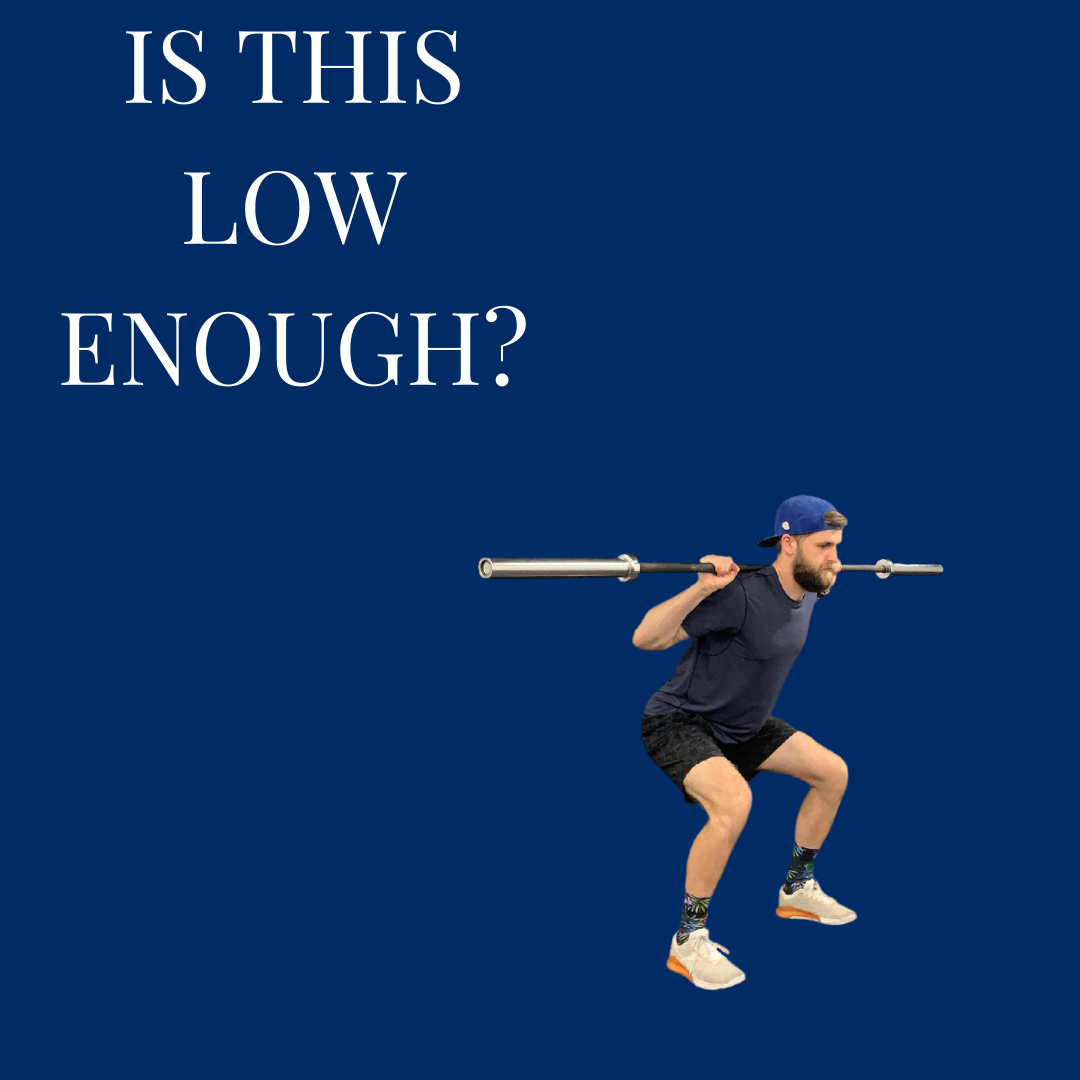
Sure in multiple competitive sports (powerlifting, CrossFit) that depth would not pass in competition. But is the person competing? Are they missing sufficient hip/knee or ankle range of motion to go lower? Are they working through an injury and want to gradually reintroduce depth? Is their training sport specific (volleyball, basketball, hockey) where they want to get strong in sport-specific positions?

Sure this depth meets competition standards for powerlifting and CrossFit. But this depth is likely lower than needed for an athlete to maximize performance in powerlifting. For athletes who want to compete in olympic weightlifting this is a great position to develop.
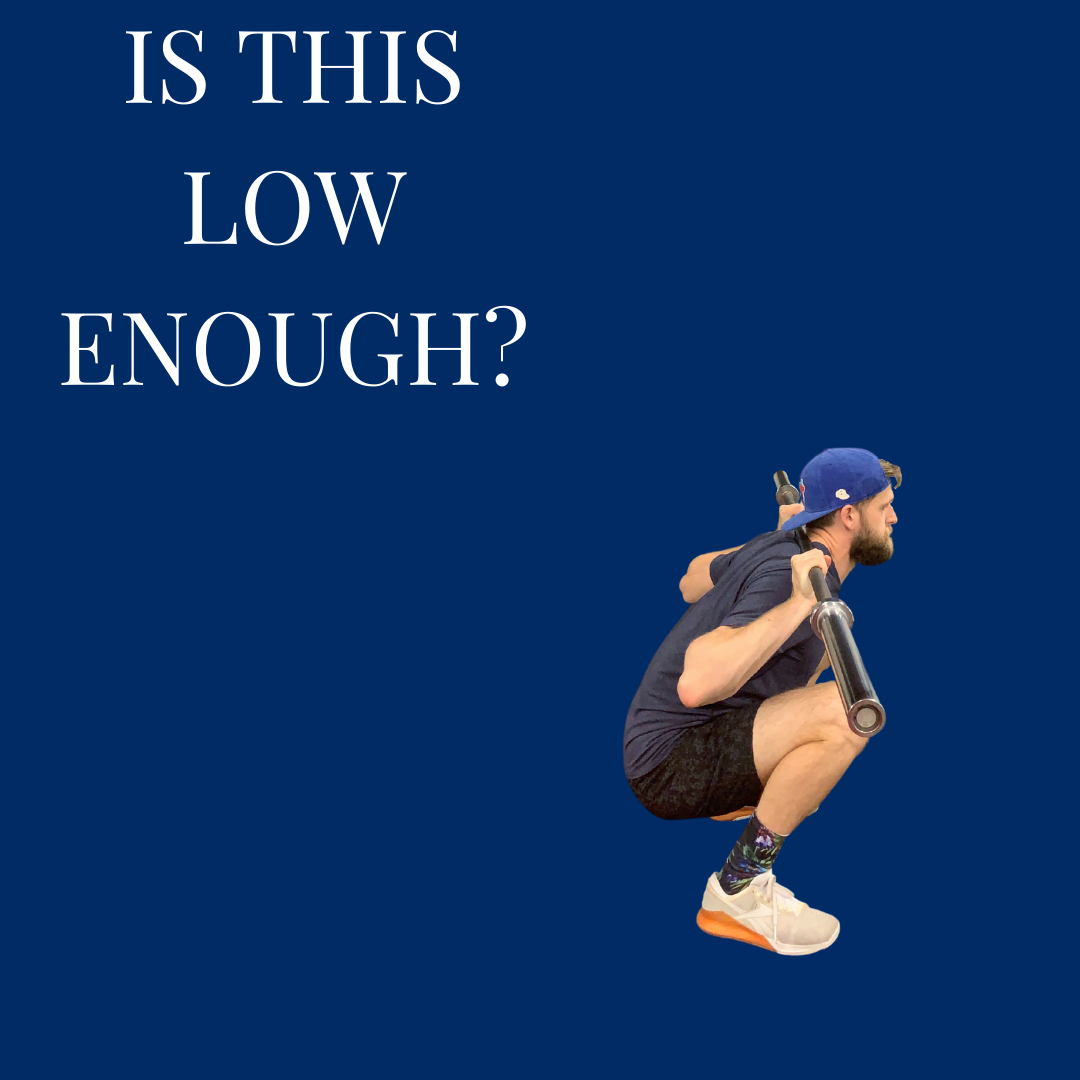
Sure this squat is low, but at what cost? We can tell this athlete to go low to meet some standard, but is their body capable of that standard? Do they have the range of motion to get into that position? Do they have the breathing and bracing mechanics to remain there safely? Won't know without assessing.
When Does Recovery Start?
When does your recovery start?
What do you do immediately after an intense workout? What is your post workout routine?
Do you stretch? Do you roll around on the ground? Do you hunch over and lean on your knees? Do you chug a bottle of water? Do you contemplate your existence?
Any of those things could make sense assuming there is intention to it.
When that workout finishes, when that last rep is done, when the clock beeps, what I often notice is what could be described as chaos.
That chaos often lacks intention.
When your workout stops, don’t stop.
Don’t stop functioning. Start recovering.
This means breathe, this means move, this means lower your heart rate.
Your cooldown starts as soon as your workout finishes.
It’s fine to lay down on the ground on your back or hands and knees after a workout. That’s assuming there is intention to it. Those positions are actually the easiest positions to work on your breathing mechanics. Get back to nasal breathing as soon as you can.
It’s fine to stretch after a workout. Maybe you have any area of your body that you know needs some additional attention. Maybe it helps you relax and calm down. That’s intention.
Workout ends, recovery starts.
For most of us, we are TRAINING to be healthy and fit. If we are in a position where we are consistently incapable of focusing on our recovery after a workout ends, we are likely regularly overtaxing our system.
Now if you are COMPETING for an Olympic medal (or insert athletic competition), do whatever you want, you’ve earned it.
70%>100%
When is 70% better than 100%?
Yes that math doesn’t add up.
But what if the conditions for you feeling 100% are as rare as winning the lottery.
If you have 70% to give, give it. If you have 55%, give it.
If you aren't feeling 100%, that's ok! Who ever actually feels 100%?
If you wait for the perfect conditions, you will likely be waiting for a very long time.
Give what you have and you will set yourself up for progress.
Want to move the needle? You need to start somewhere. Wherever you are at is a great place to start.
Concept inspired by: @erinruppertfitness
Stress Is Best
Is stress bad for you?
Is stress bad?
Stress is commonly associated with being a negative thing. But is it?
It’s fair for people to be confused with stress or to give it a negative association, as the definitions out there tend to be a bit confusing.
Definition 1 (Meriam Webster): a state resulting from a stress.
Well, that’s not helpful. Basically says “X is a result of X”.
Definition 2 (Meriam Webster): a physical, chemical, or emotional factor that causes bodily or mental tension and may be a factor in disease causation.
Well, that sounds awful. Disease causation sucks.
Definition 3 (Hans Selye): Stress is the nonspecific response of the body to any demand.
Now, this is more helpful.
Demand>Response>Stress
Stress is positive when we have a positive response.
Stress is the reason people get stronger, fitter, more resilient, and reduce the likelihood of injury or disease. That improvement came out of adapting to that stress.
Stress is also the reason people can become burnt out, injured or sick.
It’s a double-edged sword.
So how do we improve this?
Recover. Stress our bodies to levels that we are capable of recovering from. If we are not recovering we are not adapting to the stress. Results require adaptation.
Improve stress responses. When you are feeling elevated levels of stress, how do you respond? Does your heart rate increase? Does your breathing change? Do you get sad, angry, quiet, loud? Does your response match the situation? Sometimes we respond in ways that may not be favourable.
Adjust what you can. Sometimes we ask or are demanded too much. This may require asking for help.
Should I Exercise More?
Do you really need to exercise more?
So this is one of those “it depends” questions.
So let’s narrow it down and be a bit more specific.
Let’s assume exercise is already a part of your routine. It’s an important part of your day but you are not sure if what you are doing is enough. You see other people in the gym working out for hours and hours. You wonder if that should be you. But you also know that you have other responsibilities. Maybe you have a busy job. Maybe you are a student. Maybe you have kids.
So should you exercise more?
Probably not. Like I really doubt it.
Are you making progress? Are you seeing results?
If you answered yes then keep doing what you are doing! It’s working!
Now let’s say your answer is no.
Maybe something needs to be optimized. Maybe your sleep could be improved. Maybe the way you fuel your body could be improved. Maybe your stress could be managed more optimally. Maybe your training needs to be more specific to the results you are looking for. Maybe the results you are looking for will come if you continue the course.
Note that all of those possibilities do not require you to exercise more.
I believe that we live in a world where it is so easy to be influenced by others.
You see the gym member who trains 2-3 hours a day. But do you know why?
Are they trying to compete in a sport?
Is training their social time?
Is training their job?
You follow someone on social media who posts workout videos all the time.
Were the videos prerecorded?
Do they use workout videos to gain followers?
Do they use workout videos for personal accountability?
Another question you can ask when comparing your exercise volume to someone else's: Is that person like me?
In the world we live in it can be easy to want to do more because of the influence of others. But maybe the people we are comparing ourselves to are on a completely different path than the one we are on.
Any questions coming up from this? Ask away!